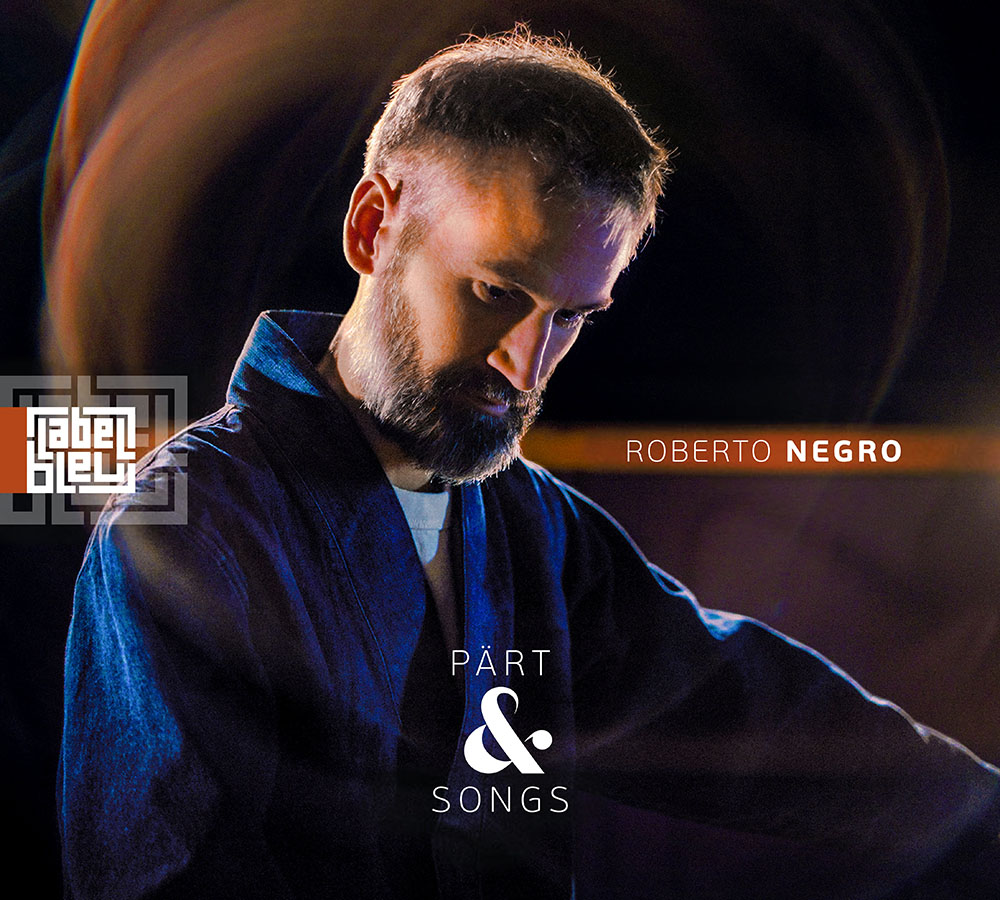
Pärt & Songs

Intimate solo

Roberto Negro sets Arvo Pärt’s piano works in dialogue with his own compositions, songs and improvisations.

In partnership with France Musique.

Listen to the album

Line-up

Roberto Negro
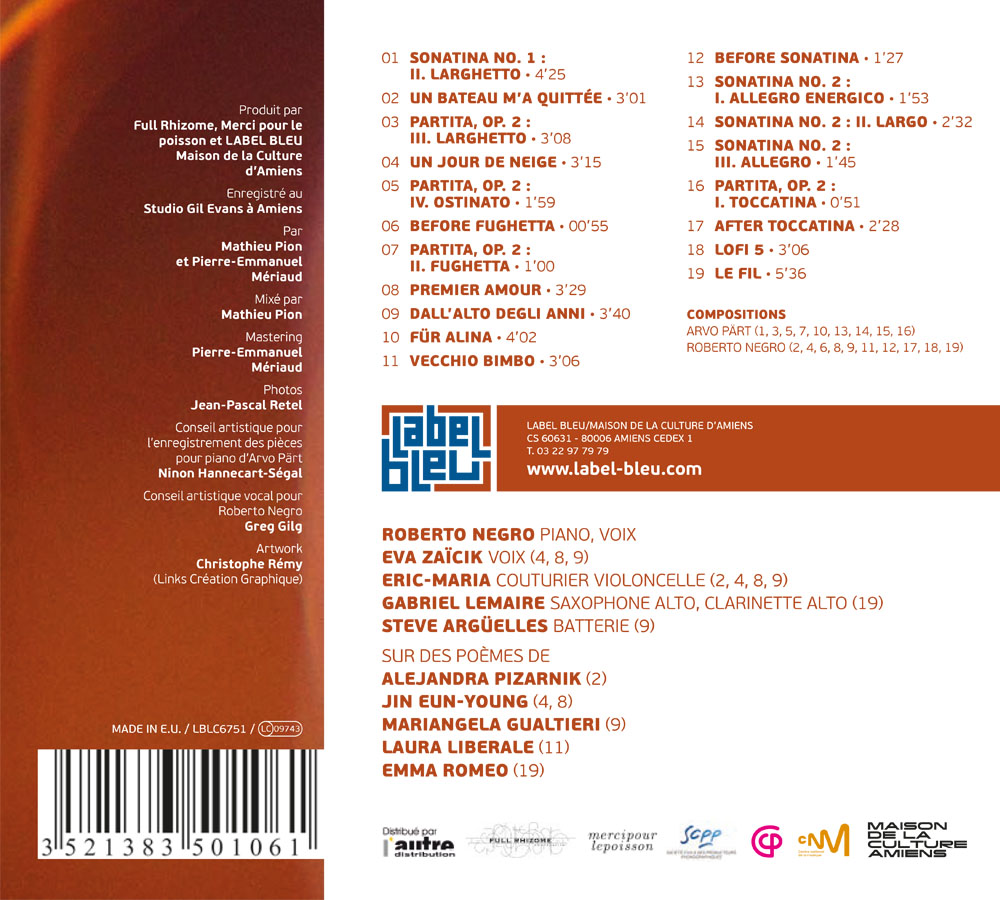
composition, piano, voice

Guests

Eva Zaïcik
mezzo-soprano

Eric-Maria Couturier
cello

Gabriel Lemaire
alto clarinet, alto saxophone (on “Le Fil”)

Steve Arguelles
percussion (on “Dall’alto degli anni”)

Poems

Alejandra Pizarnik

Jin Eun-young

Mariangela Gualtieri

Laura Liberale

Emma Romeo

Presentation

I chose to centre this album on the music of Arvo Pärt: to perform some of his piano works, those of the 1950s (with one exception!), and to write from them, in their vicinity, in their momentum. The writing was nourished by very short cells taken from the Pärt pieces on the album, like a genetic material from which new creations emerged. Like an inheritance that, passing through me, finds other forms, other lights.

This album becomes a place of imaginary encounters. Pärt’s motifs meet those of Alejandra Pizarnik, Laura Liberale, Jin Eun-young and other contemporary women poets. In their words, I find the same attention to silence, to restraint, to what seeks to appear beyond words. These poems naturally open a space for song, for more intimate vibrations, letting the fragilities of our time show in filigree. The music moves at its own pace, sometimes grave, but always crossed by a discreet mischief.

The listening can wander freely. The journey is organised into two great landscapes: one around the Partita, the other around Sonatina No. 2, with the essential Für Alina as the tipping point. Pärt’s works appear, diffract and resonate with the songs and the other compositions. For me they have become less references than presences, with which I keep searching.
Conceived for great closeness with the audience, this solo favours listening to detail, breath and fragile resonances.

Roberto Negro

Composed in 1958, the Partita for piano holds a unique place in Pärt’s output. It combines exemplary formal clarity with striking rhythmic and contrapuntal inventiveness. Each movement explores an idea with an almost architectural intensity: the feverish fluidity of the Toccatina, the precision of the Fughetta, the suspended tension of the Larghetto, and the cumulative power of the Ostinato. This rare blend of rigour and vital momentum gives the piece a timeless dimension.

It offers the piano a playground that is at once technical, formal and deeply expressive, where every detail contributes to an overall balance of great accuracy.

Composed in 1959, Sonatina No. 2 unfolds in a deeply singular writing, both rigorous and free, where each motif seems to observe itself and transform in the mirror of its own echo.

Sonatina No. 2 stands out for its continuous flow, a fluidity that links its three imaginary movements: the momentum of the first, the meditative restraint of the centre, and the rhythmic clarity of the last, built like a rondo. The themes answer one another with an inner logic, without jolts or flourishes, as if Pärt were already seeking that secret unity between tension and appeasement, between form and breath.

The polyphonic devices (mirror lines, ostinatos, sequences) reveal the young composer’s fascination with sound architecture as much as with transparency of timbre. In this concise but dense piece, everything seems oriented towards an economy of means, a fragile balance between movement and silence. Already, beneath the rigour of the style, one senses the quest for an inner world that Pärt would never cease to deepen.

Composed in 1976, Für Alina marks a tipping point for Arvo Pärt. After years of silence, it is the first work written in the tintinnabuli style, that language of absolute clarity in which rigour and restraint become sources of light.

Two voices, distinct but inseparable, weave a space of extreme purity: the melody widens then recedes, bound to an unchanging triad. At the heart of this fragile architecture, Pärt slips in two tiny accidents: a furtive dissonance, then an unexpected coda, like a promise of something else, a breath of new beginning.

But Für Alina is above all an experience of silence. Arvo Pärt asks that it be played “calmly, in a state of elevation, listening to oneself”. Each sound seems to be born from emptiness and to return to it, suspended in a light that never goes out, a moment of pure listening, where the inner space opens.

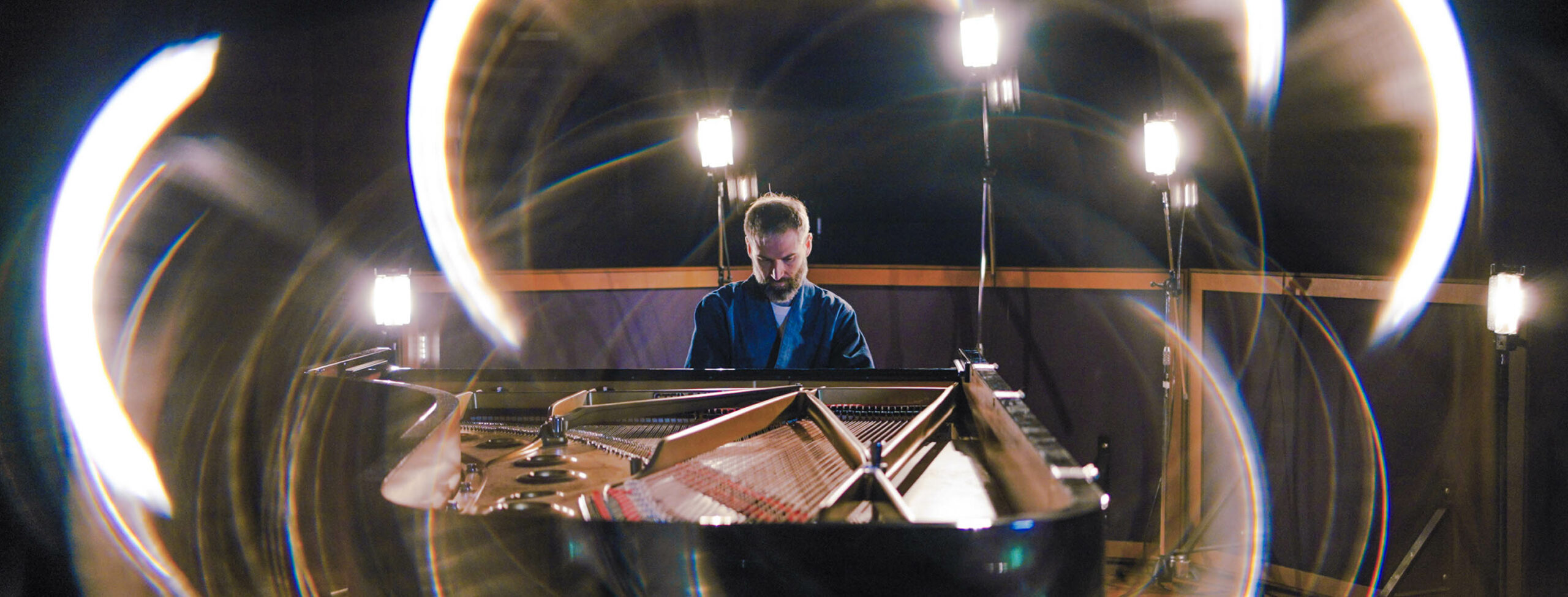
“Für Alina is the only work from his more recent repertoire that I recorded for this album. My approach is very simple: place microphones as close as possible to the piano and to myself, play as softly as possible and reveal all the sonic poetry of the mechanism that strikes or rubs and of the fabrics that rustle. This set-up shifts the piece into another temporality. A ‘Für Alina’ in context, as close as possible to the life of the piano and the pianist.” Roberto Negro

Video

Pärt & Songs │ Teaser

Arvo Pärt, Für Alina

Arvo Pärt, Partita Op.2

Podcasts

October 2026 · France MusiqueContemporary album of the week “Pärt & Songs”Roberto NegroOctober 2026 · France MusiqueGuest of the dayRoberto Negro: “I work a bit like a filter, I let a work pass through me”

Album: Pärt & Songs (2026)

Format

CD, Vinyl, Digital

Listen

Label

Label Bleu

Credits

Ninon Hannecart-Segal: artistic advice for the recording of Arvo Pärt’s piano pieces
Greg Gilg: vocal artistic advice for Roberto Negro

Recorded by Mathieu Pion and Pierre-Emmanuel Mériaud
Mixed by Mathieu Pion
Mastered by Pierre-Emmanuel Mériaud

Production: Full Rhizome
Co-production: Label Bleu

Support: DRAC AURA, Région AURA, SPEDIDAM, SCPP, Maison de Musique Contemporaine, CNM

This album is in partnership with France Musique

Art direction, production, photography: Jean-Pascal Retel

Download the press kit